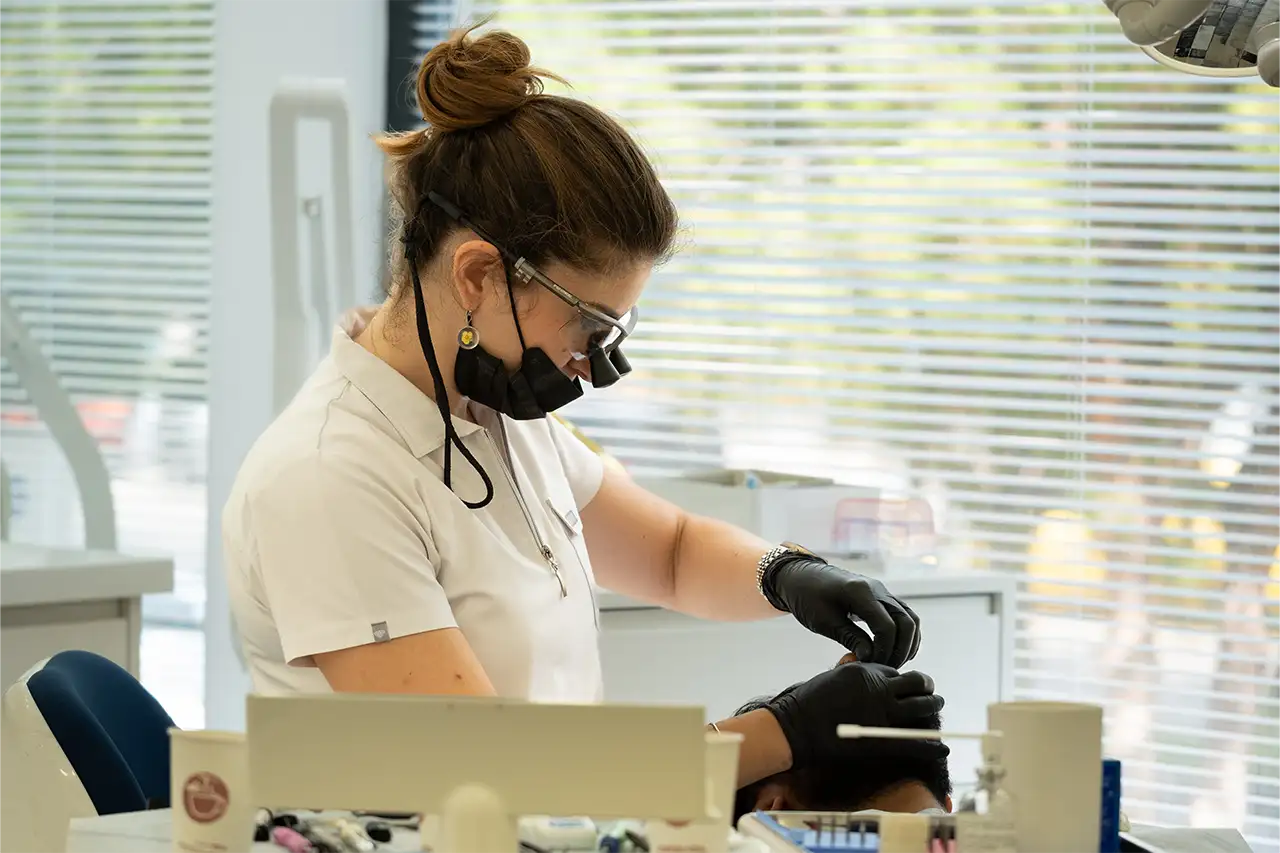

Dental implant systems, which are placed into the jawbone like a titanium 'root,' not only give you new teeth but also restore your previous quality of life. This innovative treatment, which is applied without touching neighboring teeth and transmits chewing force directly to the bone, preserving the jaw structure and accompanying you for years to come, is the strongest foundation of modern smile design.
If you also have missing teeth, Isın Dental Clinic is the right place to solve this problem; we cover the world of implants, which provides a permanent and safe solution to toothlessness, in full detail.
8 Sections
A full mouth implant (or full mouth implant rehabilitation) is a comprehensive dental treatment used to restore the entire set of teeth in patients who have lost all their teeth in one or both jaws or whose existing teeth are beyond saving. However, this does not mean that 28 implants will be placed, 14 in each jaw. This treatment can be planned in different ways depending on the patient's bone structure and aesthetic expectations. This method is based on the principle of titanium implants placed in the jawbone acting as natural tooth roots to support a fixed bridge or removable denture.
The application methods and techniques of full mouth implant treatment are as follows:
Fixed prostheses (All-on-4 and All-on-6):
In patients with no teeth, 4 or 6 implants are placed in a single jaw, onto which a fixed bridge containing the entire set of teeth is attached.
Traditional multiple implants:
In rarer cases, if the bone structure is very suitable and the patient's budget allows, separate implants can be placed for each group of teeth (e.g., 2 on one side, 2 on the other, and 2 at the front), and small bridges can also be placed on top of them. However, All-on-4/6 is both economically and surgically more advantageous.
Hybrid prostheses:
These systems, where acrylic teeth are placed on a titanium or precious metal base, are screwed onto the implants and can only be removed by the dentist.
Removable (Overdenture) prostheses:
Implants ensure that the prosthesis is firmly secured in the mouth, but the patient can remove it for cleaning whenever they wish. It is usually applied with fewer implants (2-4).
The dental implant system consists of various compatible components designed to function as natural tooth roots in place of missing teeth. This system essentially comprises a surgically placed body, gum healing components, and the prosthesis components fitted in the final stage. Modern implant systems are based on the principle of these components working in perfect harmony with each other and are produced in different diameters and lengths according to the patient's bone structure.
The main parts of a dental implant system are:
Implant Body:
This is the section that is usually made of titanium and is put into the jawbone after surgery. It takes the place of the natural tooth root and supports the abutment and prosthesis that will be put on top of it.
Abutment:
This is the portion that connects to the implant body and runs from the gum into the mouth. It is the part that connects the new tooth (crown or bridge) to the implant.
Abutment Screw:
This is the screw that holds the abutment securely to the implant body.
Prosthesis (Restoration):
The part of the implant that you can see in your mouth that helps you chew. This could be a crown (for one tooth), a bridge, or a prosthesis that can be taken out.
Dental implants used in dentistry are designed in different sizes according to the width of the jawbone and the patient's needs. The most fundamental distinction is between standard and mini implants. If you have sufficient bone volume, standard implants are the most robust and permanent solution. However, mini implants are an alternative in cases where the bone is very thin or major surgical procedures are not desired.
Standard (Traditional) implants
Standard implants are the most common and traditional method used today to replace missing teeth. They are used as the main support in both single-tooth replacement and full-mouth restoration.
- The diameter of these implants is generally between 3.5 mm and 4.5 mm. In some systems, the standard diameter is considered to be 4.1 mm. They usually consist of two parts: the implant body that is placed in the bone and the abutment that is attached to it.
- For a standard implant to be placed, the width of the jawbone must be at least 6 mm or more.
Mini implants
Mini implants are narrower solutions developed specifically for situations where there is insufficient bone volume for standard implants. Their most common purpose is to ensure that removable dentures (false teeth) remain more stable in the mouth and prevent them from moving. As they can be placed using the ‘one-drill’ technique, their surgery is simpler and, in suitable cases, allows the denture to be loaded on the same day.
- Their diameters are generally less than 3 mm. Sources often mention that they range between 2.5 mm and 2.9 mm. They usually have a design where the body and head (abutment) are a single piece.
- They are preferred in narrow ridges where the jawbone width is less than 6 mm.
- They are particularly suitable for elderly patients (aged 70 and above) who have been toothless for many years and have experienced bone resorption.
Dental implant (single tooth) procedure
If you are missing a single tooth and wish to have an implant, the process takes approximately 3-6 months and consists of several stages.
Planning (First Appointment)
Examination: Your dentist will examine your mouth, check the location of the missing tooth, and check the health of the surrounding teeth.
Imaging: This is a crucial step. Along with a standard X-ray, a 3D tomography (DVT) scan is always taken. This allows your dentist to see inside your jawbone. The height and thickness of the bone, as well as the location of blood vessels and nerves, are determined. The answer to the question, ‘Is there enough bone?’ is found here.
Treatment plan: Your dentist loads the tomography data into a special computer program. In this program, the safest and most accurate location for the implant and the angle and size at which it will be placed are planned virtually. Sometimes, a special surgical guide (guide plate) can even be prepared according to this plan.
Surgical procedure (implant placement)
Anesthesia: Local anesthesia is administered on the day of the procedure. You will not feel any pain, only the dentist working.
Gingival incision: Your dentist makes a small incision in the gum where the tooth is missing to expose the jawbone.
Preparation of the socket: Using special surgical instruments (drills), a socket is prepared to the planned diameter and depth.
Placement of the implant: The titanium implant (artificial tooth root), which looks like a screw, is carefully screwed into the prepared socket. The top of the implant is usually covered with a small screw.
Suturing: The gum is sutured closed around the implant. The implant is now completely under the gum and invisible.
Healing and waiting (Osseointegration)
A process called osseointegration begins. This means that the living cells in your jawbone firmly attach to the surface of the titanium implant and fuse with it. In other words, the implant now becomes part of your bone.
This process usually takes 2 to 6 months. Your dentist may ask you to use a temporary tooth or denture during this process.
Completion of the superstructure (Placement of the tooth)
Placement of the healing cap: Once it is certain that the implant has integrated with the bone (as determined by check-ups), a second minor surgical procedure is performed. The gum is gently opened, the cap on the implant is removed, and the healing cap is placed in its place. This cap allows the gum to shape itself and ensures a smooth emergence profile around the implant. The gum heals within a few weeks.
Taking measurements: The healing cap is removed. A measurement post is fitted in its place. A special measurement material is used to take measurements so that the dental technician can understand the exact position of the implant in your mouth.
Laboratory stage: The impression and color information are sent to the dental laboratory. Here, a tooth (crown) made of porcelain or zirconium, specific to your implant, is prepared.
Fitting the tooth (abutment & crown): The tooth from the laboratory is screwed or glued to the implant with the help of an intermediate piece (abutment). Your new tooth is now ready! It looks and feels like your natural tooth, and your chewing function is restored.
Full mouth implant procedure
Comprehensive planning and preparation
This is much more extensive than for a single tooth. Detailed tomography, photographs, facial measurements, and examination of any existing prostheses.
Tooth Extractions (if necessary): If you have teeth in your mouth that cannot be saved, they will be extracted before or during the implant surgery.
Bone grafting/sinus lift (if necessary): If the tomography shows that your jawbone is insufficient, additional procedures may be required. A sinus lift is performed in the upper jaw to build bone in areas close to the sinus cavity. A bone graft involves reinforcing the bone with material taken from another area (usually synthetic or animal-derived bone powder). These procedures extend the healing time.
Surgical session - Placement of Implants
Sedation (light sleep) or general anesthesia is usually preferred for the patient's comfort. This way, the patient feels nothing.
Your dentist, having done all the planning, lifts the gum, makes the necessary extractions, and places 4 or 6 implants with great precision at predetermined points.
Fitting temporary teeth:
One of the most advantageous aspects of this procedure is that your temporary fixed teeth are usually fitted the day after the implants are placed (sometimes even on the same day). This prosthesis is placed on top of the implants but is made of a soft material or has a light bite adjustment to prevent excessive pressure on the implants while they fuse with the bone. This means you will not be left without teeth immediately after surgery; you can continue your life with a fixed prosthesis.
Healing process (3-6 months)
The recovery period for dental implants, especially whole-mouth reconstructions like the All-on-4 approach, is a long process that starts on the day of surgery and ends with full functional integration. How long it takes to recover from dental implants and full mouth implants:
The first two weeks after surgery (Day 0–2)
- Day 0 (the day of surgery): The surgery usually takes 2 to 4 hours for one jaw and 5 to 7 hours for the whole mouth (both arches). Patients are given cold packs and pain treatment right after the surgery. Patients can start a gentle diet once they are awake.
- Provisional bridge (1–3 days): If the implants are quite stable at first, a fixed provisional bridge is usually put on within one to three days. This lets the patient depart with a smile that can't be removed.
- Get back to work: It's best to take a few days off to rest, but many patients feel strong enough to go back to work the day after surgery. After surgery, pain is usually mild and can be controlled with painkillers. It seldom lasts more than a few days.
Review after one to two weeks:
A clinical assessment will be done 7 to 14 days after surgery to check on the healing process, remove any sutures that don't dissolve, and possibly change the bite.
The healing and stabilization phase lasts from two weeks to three months.
- Soft Diet Compliance: For the first three months, it is very important to stick to a soft diet (no chewing) so that the healing bone around the implants doesn't get messed up.
- Ongoing Monitoring: Clinical reviews are done every month and every two months to check on progress and make changes to the bite as needed.
- Introduction to Hygiene: Patients usually see a hygienist after one month to learn how to clean their teeth in a specific way, as with X-floss.
- Month 3 Milestone: This is a big deal because the implants have usually bonded to the bone by this point. The temporary bridge is taken off to make sure the implants are strong and the tissues are healthy. An OPG X-ray is then taken to assess the bone levels. At this point, most patients can chew normally again.
- Definitive Bridge (4–6 Months): For upper jaw reconstructions, it usually takes 4 to 6 months for the customized final definitive bridge to be delivered.
Things that make the timeline longer
- Bone Grafting: If bone grafting is needed to make the jaw bigger before implants can be put in, it can add a year to the whole process.
- Traditional Protocols: Traditional multi-stage implant procedures that involve grafting and delayed implantation can take an average of 18 to 24 months to complete.
- Ridge Preservation: If ridge preservation is done at the same time as extraction, the bone needs to recover for 3 to 6 months before implants may be put in.
After the last bridge is delivered, regular professional cleanings and check-ups are planned every six to twelve months. Regular checks are necessary to make sure that the rebuilding will be successful and last a long time.
Fabrication of permanent teeth
Once the healing process is complete and the implants are verified to be stable, the fabrication of permanent teeth begins. The temporary prostheses are removed. The underlying implants are accessed.
Measurement: The position of the implants in the mouth and their relationship to each other are recorded using highly precise measurement methods.
Color and shape selection: The color, size, and shape (more angular or more rounded) of the teeth, suitable for your face shape, gender, age, and smile line, are determined together with you. This is a very critical step from an aesthetic point of view.
Laboratory stage: The information is sent to the laboratory. Technicians use special computer-aided design (CAD/CAM) technology to prepare a custom prosthesis for you, usually with a very strong base (zirconium or metal) and covered with aesthetic porcelain.
Fitting the prosthesis (screw retention): The prepared permanent prosthesis (all teeth in one piece) is firmly secured onto the implants with special screws. The heads of these screws are covered with small fillings.
Dental implants and full-mouth implant rehabilitation are very effective treatments that can help people who have lost teeth get back to chewing, looking good, and feeling good about themselves. But like any medical operation, these systems have their own pros and cons that need to be thought about.
Advantages of Dental Implants & Full Mouth Implants:
- Better quality of life: Implants make a big difference in quality of life by boosting the self-esteem and social participation of those who are missing teeth.
- Look and feel like real teeth: Modern implants are the best option for people who want teeth that look, feel, and work like real teeth when they chew and speak.
- Protecting the jawbone: Implants, which act like tooth roots, convey signals to the jawbone that keep it from losing bone (atrophy) and keep the face from collapsing.
- Preservation of adjacent teeth: Implant treatments do not necessitate the cutting or reduction of neighboring healthy teeth, in contrast to traditional bridges.
- High success rate and extended life: If you plan and take care of your implants properly, they can last for 10 to 15 years with a success rate of 90 to 95%. Implants that are taken care of can last a lifetime.
- Stability of the prosthesis: In full-mouth applications like All-on-4, the prostheses are attached to the implants, so they don't slip, shift, or fall out of the mouth like regular dentures do.
- Quick results (Immediate Loading): In some circumstances, temporary fixed teeth can be put in the same day as the implants, so the patient doesn't leave the clinic without teeth.
Disadvantages and risks of dental implants and full mouth implants
- Risks of surgery: Like with any surgery, there is a chance of pain, swelling, bruising, or, in rare circumstances, infection (peri-implantitis) after the surgery.
- High initial cost: Getting implants is more expensive at first than getting regular dentures or bridges.
- Length of treatment: In typical protocols, it takes 2 to 6 months for the implant to fully integrate with the bone (osseointegration).
- Bone quantity requirement: For the procedure to work, there must be enough bone; if there isn't enough bone, the patient may need to have more bone grafted, which adds time and money to the operation.
- Risks associated to habits and the whole body: Uncontrolled diabetes, other immune system illnesses, or excessive smoking might make it harder for the implant to connect with the bone and raise the risk of failure.
Turkey is becoming one of the top places in the world for dental tourism, with over 700,000 medical tourists coming there every year. Turkey has a great mix of top-notch dental care, big savings, and amazing travel experiences at well-known clinics like Işın Dental Clinic and popular places like Antalya and Istanbul.
| Procedure | Turkey (€) | Germany (€) | UK (€) | USA (€) |
|---|---|---|---|---|
| Single Tooth Implant (including abutment & crown) | €350 – €700 | €2,000 – €3,500 | €2,500 – €4,000 | €3,000 – €5,000 |
| All-on-4 (full arch, includes temporary prosthesis) | €4,500 – €8,000 per arch | €15,000 – €25,000 per arch | €12,000 – €20,000 per arch | €18,000 – €30,000 per arch |
| All-on-6 (full arch, includes temporary prosthesis) | €6,000 – €10,000 per arch | €18,000 – €28,000 per arch | €15,000 – €24,000 per arch | €22,000 – €35,000 per arch |
| Full Mouth Implants (both arches, typically All-on-4/6 or similar) | €9,000 – €16,000 | €30,000 – €50,000+ | €25,000 – €40,000+ | €35,000 – €60,000+ |
Dental Implant & Full Mouth Implant at Isın Dental Clinic for tourists:
First meeting (online)
- Send in photographs and dental records
- Video call with a specialist
- Get a treatment plan and an estimate of how much it will cost.
- Talk about dates of trip and package choices
First Visit (7–10 days)
- Day 1: Arriving, getting picked up at the airport, and checking into the hotel
- Day 2: a full exam, 3D imaging, and final planning
- Day 3: Surgery to put in the implants (2–4 hours per jaw)
- Day 4: Checkup after surgery and putting on temporary teeth
- Days 5–7: Recovery, follow-up, and modifications to the bite
Time to Heal (3 to 6 months at home)
- Osseointegration (the process of fusing bones with implants)
- Start with a diet of soft foods.
- Check-ins with the clinic from afar
Second Visit (5–7 Days)
- Last thoughts and digital scans
- Try-on of a permanent prosthetic
- Last adjustments and fitting
Why Antalya is a great place for dental tourism
A vacation and rehabilitation at the same time:
- Antalya is an excellent spot to relax and see new things following treatment. It has gorgeous beaches, a lot of history, and fancy hotels. There are several historical and cultural attractions in Antalya that are worth seeing.
- Kaleiçi, also known as the Old Town, is in the middle of the city and is like a time machine. There are buildings from the Roman, Seljuk, and Ottoman centuries, as well as boutique hotels, along its narrow streets. The ancient cities of Perge, Aspendos, and Termessos, which are not far from the city center, show how rich the area's history is. The Aspendos Theatre is one of the best-preserved Roman theaters in the world, and it regularly hosts festivals.
- Antalya's culture is more than just learning about the past. It also has classes in traditional art and local delicacies.
Advanced clinical infrastructure:
Many clinics in Antalya use the latest technology, like 3D scanning and computerized planning, and are recognized by international organizations.
Full package services:
Clinics often offer packages that include things like airport transfers, a place to stay, and a personal patient coordinator to make things easier for patients.
What is a dental implant?
A dental implant is an artificial tooth root made of biocompatible materials such as titanium or zirconium, which is placed in the jawbone to replace lost teeth.
Are dental implants and full mouth implant treatments painful?
Thanks to modern anesthesia techniques, there is no pain during the procedure. Afterwards, mild postoperative discomfort may be felt, which can be managed with simple painkillers. This is no more than what is felt after a tooth extraction.
How long does the full mouth dental implant process take from start to finish?
Think of the full mouth implant process not as a single event, but as a journey with distinct phases. While you can often get a fixed set of temporary teeth in just one day, the complete process from start to finish—from the initial consultation to biting into an apple with your final, permanent teeth—typically takes about 5 to 8 months.
Is there an age limit?
No, age alone is not an obstacle. What matters is not the date of birth, but the overall state of health. Healthy individuals aged 70-80 can easily have implants fitted. Factors such as uncontrolled diabetes, certain medications, and smoking are more important than age.
Can braces be worn with dental implants?
Yes, implants do not prevent orthodontic treatment. However, as implants are fixed in the bone, force is not applied to them; other teeth are moved instead.
What happens if an implant fails?
It is removed, the area is cleaned, and after healing, it can usually be retried with a thicker implant.